Monday, June 28, 2010

Jimmy Carter - 39th President of the United Sates of America


Atlanta is a beautiful city. I was reminded of this on my recent trip there for business. While there I took and extra day to visit the Carter Presidential Center.

June was the perfect time to visit these grounds. It is in a part of the city that is residential with the lush greens and boulevards lined with bright orange colored blossoms. The center has a groomed landscape that frames the building highlighting features of the area.

The Carter Center is my first visit to a Presidential Museum of a living President but not the first to one that served in office during my life.

A moment in time that I have always found amazingly interesting (and I think would make for a great play) includes Carter. Following the assassination of Anwar Sadat, third President of Egypt, Air Force One carried US diplomates to the funeral. As I recall, current President Reagan, Vice President Bush and Former Presidents Carter, Ford and Nixon all flew together. Ford and Carter, who had become friends once out of office, discussed building Presidential Centers. Mostly the conversation was about strategies to raise money and use them for causes.

Here I was. Visiting the results of that conversation.

Jimmy Cater was born to a family of peanut farmers. Point of interest - the first President to be born in a hospital. I had always heard his story portrayed as one of rising from the poverty of the Great Depression. However I do not believe that to be accurate. He was born during that time period, and I have no doubt things were tight, but his father owned the farm and a store along with a few other businesses. During that time to operate and own a business put you well above large segments of the population.

Later Carter went to the Naval Academy in Annapolis. He married Roslyn. He serviced on a diesel hunter killer submarine. There are some nice pictures of him in Hawaii at the center along with the uniform he wore.

After the navy he returned to Georgia to run the family business. He ran for small local governing positions over municipal bodies. This lead to a run in the State Senate where he served from 1961 to 1966.

He ran for governor in 1966 and lost. He went back to the agricultural business he been growing from the simple family farm and store. In 1970 he ran for governor again and won.

In 1976 he entered the Democratic National Party primary with a 2% name recognition. Over that year he built a base and won the important Iowa caucuses and New Hampshire primary.

The race between Carter and Ford that year showed that Carter was considerably ahead early on. But the race tightened dramatically putting the two in a tight election. Something not mentioned at the Carter Center was an interview with Playboy magazine where Carter admitted to “lust in his heart.” He also suggested questionable measures if put into office. The press also circulated that he had registered a UFO sighting a few years earlier.

In the first presidential debate since 1960 Carter did not do well. In the second debate, focused on international affairs, President Ford claimed that there was no Soviet dominance in eastern Europe. This one slip by Ford spoiled the debate for Ford and set his campaign into recovery mode. The Carter Center will tell you that Jimmy won the close election - nearly everyone else will tell you that Ford lost that election.

The main area of the Carter Center focuses on three things. The first is “a day in the life of the President.” This is a really interesting multimedia presentation on multiple screens that show one busy day and all the players involved. The second is the Camp David Accord where Carter used “Cabin Diplomacy” between the cottages at Camp David to bring together Egypt and Israel. This event is covered in great detail. Finally there is the Iranian Hostage negotiations. A phrase that remains with me about this section “There were two White Houses, one focused on the hostages and the other running daily affairs.”


Something I recall very well - the solar cells put on top of the White House.

There is considerable attention at the Carter Center placed on post presidential activities. All of the work and time spent on fair elections in third world countries and Habitat for Humanity.

I was surprised on how empty the Carter Canter was. How chatty the staff was with one another having open conversations speaking loudly across the floor.

Nothing was more surprising to me about my visit than the asian family who walked through the center with me. One of the members of the family was a woman in her late teens early 20’s who had a cough that sounded like tuberculosis. As I watched a video about the debates and commercials I kept an eye on her watching another video 10 feet away.

When she coughed there was not polite hand cover or the more PC cough into the bend of your arm. It was free and open carpet bombing coughing that covered everything in her way.

At one point during the video her cough resulted in her gum shooting out of her mouth, bouncing off the flat screen monitor and hitting the carpeted floor at her feet. After a good minuted passed before she stooped down, picked up the gum, and put it back in her mouth for continued chewing.

That was the highlight. That is what I remember most. Like the Carter Administration it was short, some things happened, and those things that stood out were kind of sad.


Tuesday, February 16, 2010

Benjamin Harrison - 23rd President of the United States of America

It was a typical Presidents’ Day in Michigan, cold with slight flurries. During my 5 Hour drive to Indianapolis the flurries became a deep winter storm. Arriving at the Harrison home in time for the 12 O'clock tour I was one of the few brave souls who had walked through the large wooden doors that day. Presidents’ Day is one of six occasions when re-enactors representing the Harrison family and staff warm the hearts and hearths of guests to bring life back to the historic home.

I had planned to stay for only two hours at best, but with the slow pace of the day and my interest in presidential homes and museums each of the actors “broke character” with me to talk about their passion for history.


Benjamin Harrison was the 23rd President of the United States of America. He was son to John Scott Harrison a congressman from Ohio, grandson to William Henry Harrison the ninth president president of the United States of America, and great-grandson to Benjamin Harrison the fifth person to sign the declaration of independence in his role representing Virginia.

Benjamin Harrison was a one term president bookended by Grover Cleveland, the only president to win two non-consecutive terms. The Harrison story always begins with Cleveland’s wife telling White House staff that they will be returning, then ends as Cleveland, his wife and the famous baby Ruth triumphantly return. Harrison is lightly sprinkled in between.

The story that I learned about Harrison was his great love for his first wife Caroline. They met as teenagers, introduced by his professor which happened to be her father. From this time on they were great companions who loved each other very much. Like most couples they filled each others gaps. He was shy and “glacial” in making decisions, she was bright and engaging in many social circles.

The First Lady graduated from college studying art and music. He went to Miami of Ohio and passed the bar without formally going to law school, instead studying under great legal minds of his time.

Their home is filled with lovely art she created. Watercolors primarily and carefully crafted plates. Caroline created China Room for the White House to display all of the patterns from past Presidents. She was the first leader of the Daughters of the American Revolution.

He took great pride as a general during the Civil War raising troops and training them to become one of the most disciplined divisions that fought. Harrison was a supporter of President Lincoln and continuously spoke of giving former slaves the right to vote. He also served as a senator from Indiana.

In October of 1892 Caroline Harrison died of tuberculosis. During the months building up to this Benjamin Harrison was by her side filled with grief and despair as she wasted away. He had accepted the Republican Party nomination to run for a second term but did not have the heart to run the campaign, it was broken at Caroline’s bedside.

During the years of mourning President Harrison returned to Indianapolis. He kept in touch with Caroline’s personal assistance and nice Mary Scott Lord. Mary lived in New York and would have dinner with the President when he was in town. She was a few month younger than the Presidents daughter.

Mary and Benjamin had a great much in common and eventually married. This caused a divid in the family between. Benjamin and Caroline’s children were not happy with the speed in which the two married. They were not pleased with the great gap in age.

Harrison and his second wife had a daughter. His remaining years were in Indianapolis home. The family never reconciled before his death.

One of the most interesting artifacts on display at the Harrison home is a handwritten note to the president in regards to his ill wife from Helen Keller. It has been authenticated that Helen wrote it herself.

My drive home was delayed due to all the time spent at the Harrison home. I made it to my second destination, The Dan Quayle Vice Presidential Museum just in time for the 4:30 pm closing.
It was either there at the corner or the rough Indiana back roads where my rear tire picked up a bit of metal. My tire pressure dropped. At a garage in the middle of nothing I attempted to change my flat only to find that the key to the tire lock is no longer in my car. The trip was much longer as I had to stop every 30 minutes to fill the tire at a gas station only to race on for the next 30 minutes before the sensor light came back on.

The extended evening allowed my mind to drift through the lives of the First Family of the 23rd President. You don’t plan to be married multiple times or push your children away with your choices - but you are grateful to find someone to share life with. You may have the best intentions to adopt the McKinley Act - raising tariffs and switching to a gold/silver standard for the US economy. It seems like a good idea at the time, but you’re setting yourself up for failure.

Sunday, July 5, 2009

Herbert Clark Hoover 31st President of the United States of America 1929-1933


Our history is filled with conspiracy theories. The media propagate and support them. Perhaps it is in our nature to be suspicious. I am one who does not believe in a second gunman, the Main was destroyed by her own government to start a war, or that there is an alien cover up in the desert of New Mexico. I don’t want to believe. Our government has a hard enough time keeping it moving to be distracted.

This Fourth of July weekend I drove to Iowa to learn about President Hebert Hoover, our 31st President of the United States of America. His boyhood home is in a small town off of Eisenhower’s great Highway 80.

Iowa is lush and green this time of year. The vast emerald farmland rolls for miles in each direction. You would never know that just over the ridge off the freeway are these fun little towns. “The Midwest Farmers Daughters” really are something to be admired. These towns are where they reside.

My hotel is called the “Presidential Inn” and is reviewed on Yahoo as having “friendly owners” and “a great place to stay for the price.” While these descriptions are accurate I may have also included that it is not really a hotel, but a motel. I would have also recommended watching the 1980’s horror movie classic “Motel Hell” which I believe was based on this location. While no one came at me with an axe or wanted me to meet their mother in the main house, it was in a state of “new ownership repair.” On a plus, they have free wireless Internet that worked some of the time. Rather than replace the old television that did not work with the new digital format, they left that big old thing in the room and mounted a new smaller television on the wall. It only got four channels, three of which were HBO - Family, West Coast, and Latin.

In town is a restaurant called “Come Backs”. There is a double meaning with the sports teams that they root for and that they would like you to return as a patron. The owner, his wife, daughter, and another “Midwest Farmers Daughter” really made me feel all right. I also had what may have been the best steak and beans in the last three years. Local beef with just a little something extra “Come Back” is a must stop when driving through Iowa on 80.
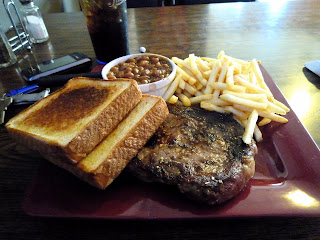

Saturday I awoke early still on Eastern Time. I am told that there is a free breakfast in the lobby - which turns out to be bad coffee and do it yourself toast. Across the street is the truck stop and McDonalds. The walls of the McDonald’s are covered in Hoover. I get excited for the day even though it has been raining hard since midnight.

Two minutes later I am over the bridge and in the parking lot of the Museum and Library. The rain is hard. There is a reason that Iowa is so green and lush.

While the puddles grow and I listen to “Car Talk” federal park rangers for the Herbert Hoover National Historic Site turn lights on, unlock doors, and prepare for the holiday rush.

There is a short film in the federal center. It is an overview of his life. In twelve minutes I learn that he was orphaned at a young age, was a Quaker, lived in Oregon with his Aunt and Uncle, was in the first class at Stanford, became an engineer, and traveled the globe before becoming President.


I cross the grounds, umbrella in hand, to a small white wooden house. There are two rooms - a bedroom and a general room. “Bert”, as they called him, was the middle of three children. The three plus mom and dad lived there for much of Bert’s childhood. On the grounds you will also find the shop where his father was the blacksmith, the Quaker meeting house where they would pray, the school house his mother taught in, and other houses from the time.


In the midst of the deluge I head back to my car and drive a block or so to the Herbert Hoover Presidential Library and Museum. Once again I am met by another wonderfully nice Iowan. She talks me through the exhibit. She also reminds me that for the holiday they have special band and “Lincoln” presenter that afternoon.

After Stanford Hoover was broke. He took a job as a miner in an awful place in Australia. After a year he went from one bad mine to another. But this time, with experience, he became the chief of operations. The British owners were very happy with his ability to turn a huge profit and asked him to fix one of their mines in China. He married the love of his life and college sweetheart Lou Henry. On arrival they found themselves in the midst of the Boxer Rebellion. Lou and Bert fought off advances and survived several near misses until the U.S. navy could escort them out of the country.

I imagine that this would be equal to me getting married and moving to the green zone in Iraq in early 2002.

Hoover went on a world tour of mines that needed to be turned around. It made him very rich. It also put him in proximity to some key historical moments in the early 20th Century.

At a moment played down in the exhibit, his with Lou and their two boys were scheduled to be on the Lusitanian on her final voyage.

The start of “The Great War” stranded the family and many Americans in the United Kingdom. Hoover was able to coordinate safe passage for thousands of them with connections and management skills.

In Belgium and much of Europe famine was killing large segments of the population. Hoover again stepped up and organized a relief effort to feed those in need. They call a bowl of hot soup and a side of white bread a “Hoover Lunch.” His efforts even reached as far a Russia despite his dislike of the politics of the time.

His good will efforts got him appointed as Secretary of Commerce by Warren G. Harding. In this position he often assumed powers not previously controlled by the government. These included standardizing and stabilizing manufacturing practices, radio signals, and flight regulations.

In 1927 the Mississippi River broke its banks and caused a devastating flood. The museum claims that it was the largest natural disaster in American history… If you agree with that or not, it was a really bad situation. Hoover was able to organize volunteers with food, boats, and medical expertise.

This series of successful actions in federal organization, feeding Europe, and domestically saving large populations built his reputation to be one of the most popular people in America. He won election overwhelmingly.

Seven months later the bottom fell out of the market. A few months’ later farmers were struggling with the dust bowl. While he put several programs in place his successor would take credit for, he became a scapegoat for the problems of Americans.

Much of the exhibit after the Market crash deals with presidents after FDR who called on him for advice, guidance and leadership. After World War II he returned to Europe to organize rebuilding efforts and programs to feed people. In fact each US President after Truman until his death called on Hoover in one way or another.

The reputation Hoover held in my mind was the start of the Great Depression. I don’t recall hearing much in history class about the other great things he had accomplished before that. The other part of Hoover I always think of is the title song to “All in the Family” a show about a protagonist who is backwards and misguided about how things are in modern times… Not a positive placement for Hoover.

I hope that history is better to Hoover. He deserves a higher rank in our minds for what he was able to do in and out of office for the United States of America.


The Hoover Center takes about two to three hours to cover in depth. It is a very good place to go with the family and learn about our history. I strongly recommend you stop by if you are driving down I-80.

Since the visit took much less time than I had planned for, and because it was raining and I did not want to wait for the band and President Lincoln presentation that afternoon, I jumped in the car and drove to Dixon Illinois.

Dixon is two hours East of the Hoover Center in West Branch and 111 miles east of Chicago. It is the boyhood home of Ronald Reagan 40th President of the United States of America.


Right now there are 13 Presidential Libraries run by the National Archives and Records Administration or NARA. Hoover is one of these places. However there are many locations and sites that are run by local organizations not associated or funded by the federal government at all. The Ronald Reagan boy hood home is such a place. Reagan requested at the opening ceremony that it would always be privately funded.

Reagan and his older brother Neil - known by their nicknames Dutch and Moon lived in this two story, two-bedroom home for only a few formable years. The family paid $15 a month rent when they were here. But that rent was too expensive and they had to move to a less expensive location.

This is what struck me most about President Ronal Reagan. He came from a very meager background (they were poor.)

The Presidential Centers I have been to up until now were often a heartwarming and humanizing way to learn history. With Reagan I found myself getting a little something in my eye every now and then. This may be because I was aware of him in my life more than these other figures in history, or maybe it was because I forgot to bring my medication with me on this trip.

They have retuned this house to a state of what it may have been like while he lived there. This is a common practice as the federal centers usually get all of the real artifacts. A huge difference with this site is that President Reagan had spent a day here in 1984 with Moon. The people who run the house were present to hear stories and memories from Dutch and Moon as they walked the halls and ate lunch in the old dining room.

If you are fascinated by the actual trinkets and artifacts that people used… visiting these homes are not for you. It is mostly looking a stuff that they didn’t own. But if you enjoy the stories that people tell, the insights you will not often get from the first three books you read on a person, hometowns are a must.


Dixon Illinois is also a really nice community. The carnival and art fair over the 4th with fireworks were delayed due to the rain, but the people in town are super nice.

Saturday night I stepped up to the Comfort Inn and watched the National Fireworks and Concert on PBS with a good night sleep that followed.

Sunday was all the great weather one could ask for. Sadly I had to drive home.

Little Known Facts About Hoover:

- Secretary of Commerce under Harding, Secretary of Commerce under Coolidge

- The School of Engineering and Applied Science of Columbia University in 1964, Herbert Hoover and Thomas Edison were named the two greatest engineers in U. S. History

- He was the youngest member of Stanford University's first graduating class.

- During their first three years in the White House, the Hoovers dined alone only three times, each time on their wedding anniversary

Hoover was the first president to donate his salary to charity

- One of the most honored presidents, Hoover received 84 honourary degrees, 78 medals and awards, and the keys to dozens of cities

- 1874 - 1st US President born west of the Mississippi

- President Hoover had the longest retirement of any U.S. President ever, having lived for 31 years and seven months after leaving office


Reblog this post [with Zemanta]

Saturday, July 4, 2009

William McKinley 25th President of the United Sates of America 1897-1901

Originally Posted April 23, 2009

William McKinley may be our most over looked US President.

At the age of 18 he served under Rutherford B Hayes in the Civil War. His actions there merited the Medal of Honor, but when his name was in the consideration process he asked that his name be removed from consideration. McKinley claimed that his actions were no different than those of any other good Christian, and pointed out that the actions were also in disregard to a direct order fro his superior (providing food and aid to solders in the heat of battle during a fight at Antietam)

McKinley was also the last Civil War veteran to serve as President of the United States. His time in office is considered as the unification and revitalization the country had been struggling to find during “Reconstruction” many of his predecessors were unable to provide.

He won the office of President overwhelmingly on both runs. The trivia question that comes up here is “what is the name of his Vice President?” You would be correct that the second one was Teddy Roosevelt, one of the famous four stoned guys on Mount Rushmore. But his first Vice President was a poor soul named Garret Hobart who died of “kidney problems.”

You can read and interpret his domestic and international policies on your own. Like many Presidents I find he did some good, some messed up things, and had to bend to pressures of the world he could not resist.

It would be easy to gloss over a few more points with McKinley as just another politician - McKinley was a lawyer, nearly all politicians are; he was a congressman, there are many congressmen; he was a governor, many Presidents are governors; but where he starts to separate himself is when you see that he got to the White House in that order. On top of that both his daughters died at very young ages, the oldest only lived to four. His wife Ida was “distraught” afterwards to the point that she was nearly incapacitated.

A few more points on the man who I find is unjustly over looked. First, many of the successes that we think of TR for were actually set into place under McKinley. When you hear the phrase “speak softly and carry a big stick” the “big stick” TR refers to is the “great white fleet” which was in place because of the programs under McKinley. The plans for the Panama Canal were already under way when TR took office. Second, front porch campaigns and campaign buttons, both tactics that McKinley (and his advocate Hanna) made hugely successful to put him over the top in votes.

My trip was one I had planned to have a few weeks ago, before things changed with work. But I decided to go when I found a good hotel rate.

Wednesday was a four-hour drive to Canton Ohio and a stay at the McKinley Grand. It was fine for an independent hotel, and it was fine if you are going to find your self in Canton (for McKinley or the Pro Football Hall of Fame.)

In the morning I was up early, had breakfast, and there for the opening of the McKinley Museum and Memorial. The memorial is a local attraction for runners and those getting in shape on a beautiful morning. There are lots of steps and four laps around the circle drive equals one mile.

Like many memorials it is majestic and is a lasting impression of a legacy.


The McKinley Museum = Epic Fail. I didn’t think I could be so disappointed in a place. There were just as many photos and artifacts at the official “William McKinley Presidential Library and Museum” as there were at the “McKinley Grand Hotel.” But the hotel photos were larger. In this two-story building there are three glass cases of McKinley and one video in a closet sized room. The rest of the building is a promotion for local furniture production, a re-imagined turn of the century city street (all post 1900, McKinley died in 1901), a telescope, a tribute to “Hoover” the vacuum, and a basement full of bad science projects and plastic dinosaurs.

An hour and a half north east of Canton is Niles Ohio. Birthplace of McKinley and site of the “The National McKinley Birthplace Memorial.” This is a very nice building with many artifacts and interesting information on the man. Unfortunately I arrived during a three-year renovation.


The nice thing about the site is it is all about McKinley. It is a self-guided tour. This means that you call ahead and set up an appointment, or ask the very nice people there to unlock the door for you. This is what I did. They unlocked the door, turned on the lights and I spent an hour or more wandering the hall. I did not pocket anything, although I know I could have.

Afterwards one of the curators took me to the recreation of his birthplace and gave me a personal tour.

He was one of nine kids, and there were eleven people in that small house. What did he do most of the time? Well, when he wasn’t reading, he was gathering wood for the wood stove, which sounds like another son of Ohio I know.

My time with McKinley leaves me with the feeling that he is under appreciated. I did not expect the rock start status of Lincoln or the homespun midwestern values of Ford. My expectation was something along the lines of his former C.O. Hayes. But it turns out that aside from a great workout at his gravesite, he has faded in the minds of the nation replaced by telescopes, vacuums, and T-Rex. His memorial is a stone shroud surrounded by the busts of Ayn Rand characters that run empires not knowing how or why they operate.


There are a hundred plus busts tucked into every corner on these grounds. Most are powerful men of industry from the 1900's and other are political figures who served under McKinley. The busts were a fund raiser.

He died as a result of an assassin shot, before he could plan his legacy. Both children passed long before that day. His wife was in no state of mind arrange how we would remember him. So I guess it is just by practical means that we have few artifacts and articles outside his policy and work to remember him by.


This poster are the remains of a campaign banner that is over 20 feet tall


This sign has an error... but points out the banner in the window or the picture below


This is the same building today.


Reblog this post [with Zemanta]